
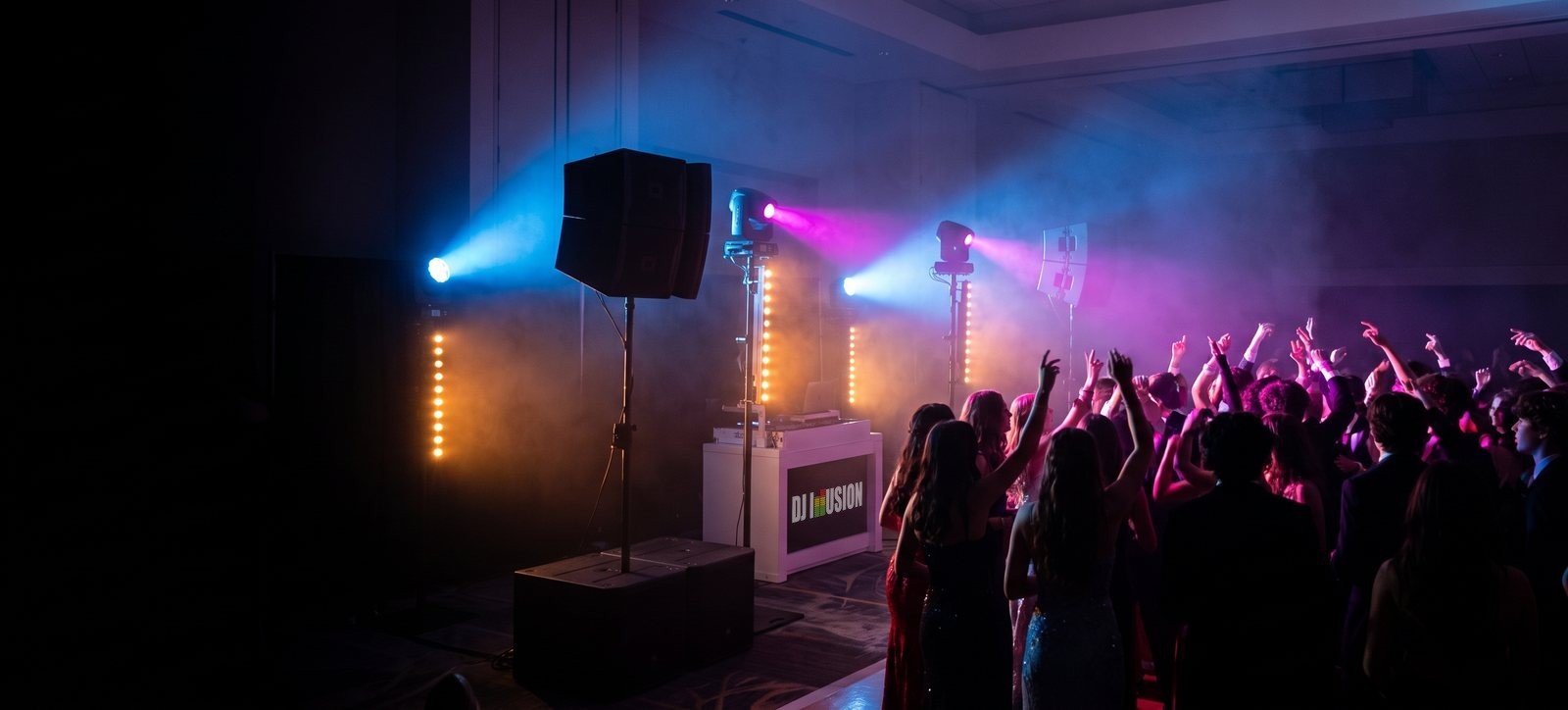
Published August 2026.
Homecoming planning goes wrong in the same place almost every year: entertainment gets booked last, after the date, the theme, and the decorations are already locked. This guide for ASB advisers and activity coordinators around Seattle runs the other direction, starting with the decisions that cannot be undone and working forward to the run of show. It covers the full-year timeline, budget lines with real dollar figures, chaperone logistics, ticket and guest-pass mechanics, the questions to ask any DJ before signing, and a printable checklist for your first meeting. It is written by a working school dance DJ, so the vendor-side details that decoration catalogs and ticketing platforms leave out are here.
What does the homecoming planning timeline look like at a glance?
A homecoming dance takes about a school year to plan properly, and the four decisions that cannot be reversed cheaply are the date, the venue, the entertainment, and the ticket price. Everything else can move.
- Spring or summer before (6 to 12 months out): Shortlist two or three dates against the athletic and district calendar, walk the venue before you sign for it, check availability with the venue and your entertainment, then announce the date and book. Seattle-area schools cluster on the same Saturdays in late September and October, so this is the window where you actually have a choice.
- First week of school: Seat the committee, assign leads (budget, publicity, decor, tickets, chaperones, vendor contact), and open the budget worksheet with your bookkeeper.
- 8 weeks out: Lock the theme, set ticket prices from the budget, and start the purchase order or contract paperwork. Request certificates of insurance from every outside vendor now.
- 6 weeks out: Order decorations and supplies. Custom decoration orders commonly need several weeks of lead time, so confirm the lead time with your supplier before you promise the committee a delivery date. Confirm custodial and facilities coverage in writing.
- 4 weeks out: Open ticket sales three or more weeks before the dance, launch publicity, and start recruiting chaperones by name.
- 3 weeks out: Confirm the chaperone roster in writing, submit guest permission forms, and send the song request questionnaire and do-not-play list to your DJ.
- 2 weeks out: Walk the venue again, this time with facilities and the vendors who will be in the room. Confirm load-in access, power, and the haze and smoke detector policy. Confirm vendor arrival times and name your single vendor point of contact.
- Week of: Close ticket sales, print the run of show, and brief chaperones on zones and escalation.
- Day of: Vendors load in 1 to 3 hours before doors. Walk the room once with the DJ, then let the vendors work.
- Monday after: Reconcile the budget, write down what broke, and hand the file to next year's committee.
Want this as a fillable checklist?
Every task in this guide is pulled into a single 48-item checklist, phase by phase, with a box for each step and a place to write who owns it. Fill it in onscreen, or download the PDF and type straight into it. Free, no email required.
When should you start planning a homecoming dance?
Start in the spring or summer before the dance. Homecoming and prom dates book 6 to 12 months out because schools across a region land on the same handful of Saturdays, so a committee meeting for the first time in the second week of school is choosing from what is left.
An eight-week timeline is not hopeless, but the work changes: move fast on what is still open, and accept the constraints on what is not.
What should be locked before school starts?
The summer list should include the date, the venue, the entertainment, and the total budget ceiling. Each one constrains what the student committee decides later, and each costs real money or real goodwill to change once announced.
- Build a shortlist of two or three dates from your athletic and district calendar, then check availability with the venue and every vendor before you announce one. The athletic calendar is the first gate and nothing moves ahead of it. But treating a single date as fixed before you have called anyone is how committees end up with their fourth choice of everything. Moving the date after it is announced costs everything.
- Consider a Friday, with one large caveat. Homecoming week is usually built around a Friday home football game and rally, which is exactly why most schools hold the dance on the Saturday. Check your athletic and rally calendar before you assume either night is free. Where a school does have flexibility, Friday dates are easier to secure, both at off-campus venues and with in-demand vendors.
Get your vendor contracts signed over the summer even if the purchase orders cannot be issued until the district reopens. A homecoming usually involves several: the venue if you are off campus, the DJ, and any add-on such as a photo booth. In my experience most school dance vendors will hold a date on a signed statement of work and invoice against a PO later. DJ Illusion holds dates this way, and already has master services agreements with many Greater Seattle districts.
Walk the venue before you sign for it. The walkthrough two weeks out is for confirming load-in times and power with the people who will be in the room. Whether the space works at all belongs before the contract, while you can still choose a different room: its size against your expected attendance, where sound can go, whether there is a ground-level door.
Why is the date the highest-leverage decision?
The date determines your attendance, and attendance determines your budget. A dance scheduled the same night as a late away game produces a crowd that arrives at 9:30 p.m., tired, in two waves, and half of it leaves early.
Check the district calendar too: testing windows, local college move-in weekends if your school draws alumni, and any community event that uses the same custodial staff. Then publish the date, because every other lead is waiting on it.
How much does a high school homecoming dance cost?
A high school homecoming dance in the Seattle area typically runs a few thousand dollars, with entertainment as the single largest line for the dance itself. Anderson's, a school dance supply retailer, published in July 2026 that most homecoming dances land between $3,000 and $15,000 total, or $20 to $60 per student. That figure comes from a vendor blog rather than a survey, so treat it as a rough frame and build your own worksheet from real quotes.
What are the budget lines every homecoming needs?
| Line item | What to watch |
|---|---|
| Venue and custodial | Often free on campus, but custodial overtime is not. District rules usually bill time before and after the event as well as the event itself, and many set a minimum number of billable hours, plus a custodian on duty whenever the building is open. Get the hourly rate and the minimum in writing. |
| DJ, sound, and lighting | Usually the largest single line. Priced by group size and hours, not by playlist. |
| Decorations and theme supplies | Cap this number before the committee starts shopping. Order 6 to 8 weeks out. |
| Add-on experiences | Mostly the photo booth, which is what schools order. Three formats, in increasing cost: a self-serve digital booth, a staffed booth that prints, and a 360 booth at the top end. Not every vendor carries all three, so ask before you budget for one. A staffed booth also gives non-dancers somewhere to be; nobody works a bare backdrop after the first twenty minutes. |
| Refreshments | The one line that scales with attendance, so price it per head, commonly $2 to $6. Size it from advance ticket sales. |
| Publicity and printing | Posters, tickets, wristbands, banners. |
| Security and staffing | Per district policy. Confirm whether off-duty officers are required. |
| Contingency | Hold 10 to 15 percent back. Something always comes up. |
Get every vendor quote in writing before you take numbers to the ASB governing body for approval. The bookkeeper administers the account, but the ASB approves the spending. And spend on the dance floor before you spend on the walls. Students remember whether they danced, and administrators notice how long they stayed.
How should you price homecoming tickets?
Price tickets from the budget, not from last year's price, and split the budget in two before you divide anything. Fixed costs stay the same whether 250 or 550 students show up: the DJ, security, custodial, decorations, printing. Per-head costs rise with the crowd, and at a dance that is mostly refreshments. Dividing every cost by attendance, which is the easy thing to do in your head, recovers the fixed side and quietly leaves the per-head cost uncovered.
Break-even attendance is the point where ticket revenue covers the fixed cost after each ticket has paid for its own per-head cost:
Break-even attendance = fixed cost / (ticket price - per-head cost)
Use a conservative planning attendance of 60 to 70 percent of last year's actual count, price so break-even lands below that, and let anything above it be upside. Then divide break-even by your enrollment and read it as a percentage. If break-even needs 40 percent of the school and last year drew 28 percent, the price is too low or the costs are too high, and no amount of publicity fixes that. Close any remaining gap with ASB funds or a sponsor rather than by cutting the entertainment.
Build a ladder rather than a single price. An ASB cardholder discount, usually $2 to $5, doubles as a reason to buy the card in the first place. Escalating date tiers do the rest, usually two to four windows that step up as the dance approaches. Open sales at least three weeks out and let the price rise in the final week or two. The tiers pull purchases forward, so you get a real headcount early enough to size food, staffing, and decorations, and early enough to tell whether your attendance estimate is holding.
For a local sanity check, Seattle-area homecoming tickets generally run somewhere between $10 and $40, with tier steps of about $5. Some schools set a deliberately steep final-days price to close sales rather than to sell at it.
If you sell online, most ticketing platforms pass a per-ticket fee to the buyer. GoFan, for example, is free to the school and covers the card fees, but charges the student $1 on a ticket of $10 or less, or $1 plus 5 percent above that, so a $20 ticket rings up at $22. Others, such as RevTrak and SchoolPay, let the district set the convenience fee and decide whether the student pays it or the ASB absorbs it. Add the fee to your number before you publish it, because the student pays the total.
How do fee waivers change your ticket price in Washington?
Washington districts have to waive fees for low-income students, and a dance ticket is on the list. OSPI's guidance on House Bill 1660 names "admission tickets for games, performances, and dances" among the fees covered. This is a plain description of that guidance rather than legal advice, and your district's business office is the authority on how yours applies it.
OSPI's guidance is that charging and collecting should work the same way for every student regardless of free or reduced-price meal eligibility, and that a waiver should apply automatically. In practice that points away from a separate window, a separate line, or anything that makes a student ask in front of other students. Ask your bookkeeper how your district wants that handled before you design the ticket table, and what share of tickets to expect on a waiver. Plan attendance and refreshments against the full crowd, and revenue against the paying share.
What does school dance entertainment actually cost?
Budget roughly $999 to $4,499 for a three-hour school dance, depending on your crowd size and how much lighting you want. That is what we see in the Seattle area, not a surveyed figure. Build your worksheet from real quotes.
What moves you through that range is bodies, not playlist. Sound and lighting scale with the size of the room and the crowd in it: more students means more speaker to cover them evenly and more light to make a bigger space read as a venue rather than as a lit gym.
Vendors band that differently, and some price flat or purely by the hour. The bands below are how DJ Illusion structures its own packages, and a useful frame for reading someone else's quote:
| Crowd size | Package | 3 hours | What changes at this size |
|---|---|---|---|
| Up to about 150 | Essential | $999 | A commons or a small gym. One sound position and basic dance floor lighting. |
| Up to about 250 | Spotlight | $1,499 | The same room with twice the lighting, which is where most smaller dances land. |
| 250 to 500 | Main Event | $2,099 | A full gym. A bigger sound system to cover the room evenly, plus uplighting in your school colors. |
| 500 to 700 | Full House | $2,799 | More sound again so the back of the room hears what the front does, and double the uplighting. |
| 700 to 1,000 | Club-Style | $3,499 | A main gym or a large off-campus room. Substantially more of both sound and lighting, and more labor to set it up. |
| Up to and exceeding 1,000 | Headliner | $4,499 | The full production, chosen for the light show, not just the head count. |
Prices shown are current as of August 2026.
Ask where your expected attendance falls against a vendor's own tiers before you compare two quotes, because a cheaper number for a smaller rig is not a cheaper vendor. The full specification behind each package is on the school dance packages and pricing page, so you can hold another vendor's quote against it on the same terms. Nothing here is a quote for your dance. For how school dance pricing compares to other event types in the region, see how much a DJ costs in Seattle.
Can you pay for a homecoming dance with ASB funds?
Yes, ASB funds can pay for a homecoming dance in Washington, but the spending has to be approved before it happens, and by two bodies. RCW 28A.325.030 establishes the associated student body program fund. The ASB budgets the fund subject to approval by the school district's board of directors, and every disbursement requires the prior approval of the ASB's governing body as well as the approval of the school board.
This is a general description of a public statute, not legal advice. Districts vary in how they implement it, so confirm your exact order of operations with your bookkeeper before you rely on the list below. The general shape most business offices expect:
- Get a written quote from the vendor.
- Take the expenditure to the ASB governing body for a recorded vote before signing anything.
- Sign the statement of work or contract.
- Have the bookkeeper issue the purchase order referencing that contract.
- Pay against the vendor's invoice on district terms.
The WASBO ASB manual, which is the reference many Washington business offices work from, states that "contracts that require a deposit are acceptable but otherwise pre-paid contracts are not allowed," and it lists disc jockeys among the personal service contracts it covers. The shape that follows is a retainer or deposit to hold the date, then the balance after the event against an invoice. Confirm the structure your district accepts with your business office, and check any quote against it before it reaches district review.
OSPI's accounting manual for public school districts puts four signatures on the activity purchase order: the student activity treasurer, the activity advisor, the ASB central treasurer, and the primary advisor. The same four sign the payment order after the event. The manual also holds that no activity may end with a negative balance. In practice that means the money is in the account before the commitment is made. Your bookkeeper's calendar sets how fast a booking closes.
Vendors who work with schools regularly already know this sequence. DJ Illusion works with Greater Seattle districts on purchase orders and net 30 terms, and can work from ASB funding or parent committee checks. For public funds, expect to pay by purchase order and invoice. Ask your bookkeeper which payment forms your district allows, and check early that your vendor can work that way.
What should you ask a school dance DJ before you book?
Ask six questions, and pay as much attention to how the answer arrives as to what it says. A vendor who works schools regularly answers all six without hesitating, because every district asks the same things.
- Do you play clean, radio-edit versions only, and who verifies that? This is a procurement question, not a taste question. Your administrators will ask you, and the answer needs to cover live requests too, not just the planned set.
- Can you provide a certificate of insurance naming the school and district? Districts commonly require proof of general liability coverage, and a figure on a website is not proof of cover on your date. Ask for a current certificate rather than a stated limit. DJ Illusion issues custom certificates on request.
- Has every person you send to my campus been background screened? Not just the DJ. Assistants and photo booth operators are on campus around students too. Ask what screening standard was used, since districts differ on what they accept. DJ Illusion background-screens the staff it assigns to school events, including event assistants and photo booth operators.
- Can you accept a purchase order and invoice on district terms? A vendor already set up with your district turns a signed statement of work into a PO with little paperwork on your end. A vendor who has not done it before can still get there, but start the paperwork earlier.
- What backup equipment travels with you? Ask specifically about a backup laptop and redundant audio and lighting, not a general reassurance.
- How much setup time do you need, and what access do you require? The honest answer is a range tied to the package and the room.
A newer vendor is not a worse vendor. The answers just have to be specific enough to write into a contract. If a quote does not state hours, group size, equipment and arrival time, there is nothing to hold anyone to.
What should the contract protect the school against?
Vendor contracts are written by vendors, and they tend to be thorough about the vendor's protections and quiet about yours. Ask for these in writing, and route anything unusual to your district's business office before you sign, since signing authority for vendor contracts usually sits with them rather than with the ASB committee.
- What happens if the school cancels. Get the refund schedule in dates, not in adjectives. What is refundable at ninety days, at thirty, at a week. Many vendors treat the retainer, the amount that reserved your date, as non-refundable. Confirm whether yours does, and pin down what happens to everything above it.
- What happens if the vendor cancels. The mirror clause, and the one most often missing. A full refund is the floor. Better is a written commitment to find a comparable replacement at no additional cost to you.
- Weather and closure. Snow, a power outage, an unplanned district closure. Decide now whether that is a cancellation, a postponement to a named alternative date, or a credit, and put the answer in the contract rather than in an email thread you will be searching for in February.
- Operator substitution. Who covers if the assigned person cannot work, on what notice, and whether you have any say.
- Force majeure, read in both directions. Most contracts excuse the vendor for events outside their control. Check whether it excuses you as well.
- What the quoted scope actually is. Hours, arrival time, group size, equipment, and what triggers an overtime charge. An overtime rate agreed in advance costs a fraction of one negotiated at 11 p.m.
- Insurance and screening as attachments, not assertions. The certificate naming the school and district, and the screening standard for every person coming on campus.
- The contractor's UBI on the contract form. A Washington personal service contract form carries the contractor's unified business identifier, and a vendor that works with schools has one ready. If yours cannot produce one, start the paperwork earlier.
A vendor who works schools regularly will not blink at any of it. This is a general checklist rather than legal advice, and your district's business office has the final word on contract terms.
Check your date before the fall rush
Homecoming Saturdays fill first, and the schools that book earliest get first pick of dates. DJ Illusion works with district purchase orders and ASB funding, and has DJ'd homecomings and school dances across the Greater Seattle area. Review school dance packages and pricing, or read what other schools have said on the reviews page.
Will a fog machine or haze set off the gym smoke detectors?
It can. Fog machines produce airborne particles, and most gym smoke detectors are built to sense airborne particles. A dense fog effect near a detector head can trigger an alarm, empty the building, and end the dance.
- Fog is not haze. A fog machine pushes a thick, visible cloud. A professional hazer produces a fine, even atmospheric layer that makes light beams visible without a visible cloud. Haze is what makes a gym look like a venue instead of a gym with lights in it.
- Detector type matters. Ionization and photoelectric detectors respond to different kinds of fires and particles, and placement relative to the effect matters as much as the effect itself.
- Some districts simply prohibit it. That is a policy decision, not a technical one, and no vendor can overrule it.
Ask facilities in writing whether haze is permitted in your room. If it is, ask facilities to confirm in writing with your local fire code official, usually your city or county fire marshal, how the room's detection system should be handled for the event, and follow their direction. Fire code requires that any fire protection system taken out of service be reported to the fire department, so this is never something a vendor decides on its own. Get the answer before load-in, not while the DJ is unpacking. DJ Illusion includes a concert-grade hazer with most lighting packages and confirms the venue's haze policy before the event, so the question should never surprise your vendor.
What about occupancy limits and a crowd manager?
The same office that answers the haze question sets these too. A gym in use for a dance is an assembly occupancy, its posted occupant load changes with the layout, and crowd managers are keyed to how many people are in the room rather than to what is happening in it, and Washington sets that threshold higher than the model code does, so ask rather than assume. Ask facilities to confirm the occupant load for your setup and whether a crowd manager is required, in writing, at the same time you settle the haze policy.
What does a DJ actually need from your gym or commons?
A school dance DJ needs four things from the room: ground-level access to unload, dedicated power near the setup position, uninterrupted setup time before doors, and a decision about where the sound and lighting go. Make sure these are reviewed ahead of time to ensure the dance starts on time.
Load-in access and parking
Ask where the truck parks and how far the gear travels from there. A vehicle that parks at a ground-level door sets up dramatically faster than one that crosses a campus, uses an elevator, or climbs stairs. If your only route involves stairs or a long push, say so in advance so the vendor can staff and schedule for it.
Power and placement
A full sound and lighting rig draws real current. Confirm which circuits serve the stage end of the room, whether they are shared with the concession equipment or the photo booth, and whether facilities needs to unlock a panel. Tripping a breaker at 9 p.m. is almost always a shared-circuit problem, not a vendor problem.
Setup and teardown time
Expect the vendor on site 1 to 3 hours before doors depending on the package, with roughly an hour for teardown. Build that into the custodial schedule and tell your decorating crew, because two crews working the same corner at the same time slows both.
Why does a gym sound bad, and what fixes it?
A gym sounds bad because of reverberation, not volume. Hard parallel walls, a hard floor, and a high ceiling send sound bouncing back into the room, so words smear together and bass turns into a rumble. The instinct to fix this with a bigger speaker makes it worse, because more energy into a reflective room produces more reflections.
What actually helps: directional speakers aimed at the crowd rather than the walls, subwoofers placed on the floor where the room supports them, and bodies. A packed floor absorbs sound. This is also why a 200-student dance in a 1,000-capacity gym is harder to make sound good than the same dance in the commons.
What does lighting do that sound cannot?
Lighting solves the other half of the oversized-room problem. It cannot touch the acoustics, but it decides how big the room feels. A gym lit by its own ceiling fixtures reads as a gym with a speaker in it, and students stand around the edges of it.
Bringing the house lights down shrinks the room to the lit area, which is why a half-empty floor under full lights feels emptier than the same crowd in the dark. Moving lights and a hazer give the beams something to travel through, so the light becomes visible in the air rather than only landing on the floor. And uplighting along the walls turns bare cinderblock into color, which makes an oversized room feel intentional rather than empty. In my experience, where a budget forces a choice in an oversized room, a dollar of lighting often does more for the feel of the night than a dollar of extra speaker. Confirm the room with your vendor before deciding.
How many chaperones do you need, and what should they do?
Get your required chaperone-to-student ratio from your district in writing, because there is no single published statewide Washington figure that an adviser can safely rely on. Ratios vary by district and sometimes by event type. Ask your athletic or activities director for the current policy and keep the email.
What the chaperones actually do matters more than the raw number.
- Assign zones, not a crowd. Name every area that needs eyes: entry and ticket table, coat and bag area, restroom corridor, the dance floor itself, the food area, and the exterior door where re-entry gets attempted. Put a name on each zone for each hour.
- Make chaperones identifiable. Lanyards or matching shirts. A student who needs help should not have to guess which adult is working.
- Brief before doors, in person, for five minutes. Cover what to intervene on directly, what to escalate, who to escalate to, where the first aid kit is, and how to reach an administrator without leaving a post.
- Name leads. One lead per zone, one overall administrator on site, and one named adult who owns the vendor relationship so the DJ is not hunting for a decision-maker mid-event.
That last role is the one most often skipped. When the schedule slips or the fire alarm question comes up, the DJ needs one person to ask.
What is your emergency plan for the night?
Your school already has emergency procedures. The gap at a dance is that the room is dark, loud, full of students, and staffed largely by volunteers who have never drilled in it. Get the district's plan from your administrator, then walk it through for this specific room before doors, and cover five things in the chaperone briefing.
- Who calls 911, and who meets the ambulance. Name both. The second one matters more than people expect: an entrance nobody is watching for costs minutes.
- How the music stops. Agree a signal with the DJ before doors so an adult can cut the sound and get the lights up in seconds without hunting for someone. A working microphone on the system is the fastest way to give one instruction to a full, loud room.
- Evacuation, for a dark room. Which exits, who sweeps the restrooms and the corridor, and where the muster point is. A route that is obvious with the house lights on is not obvious at 9 p.m. with haze in the air.
- Severe weather and lockdown. These follow your district's existing emergency protocol, not a plan the committee writes. Your job is to make sure every chaperone knows the protocol still runs in a dark, loud room, and knows who on site has the authority to initiate it. Off campus, ask for the venue's plan as part of the booking.
- Medical and first aid. Where the kit is, who on site is trained, and how a student's emergency contact gets reached. Overheating and fainting are the routine ones on a packed floor, not the dramatic scenarios.
Write the answers on the run of show. A plan that lives in one adult's head is not a plan if that adult is the one dealing with the incident.
What ticket, guest, and re-entry rules do Seattle-area schools use?
Rules vary by school, so treat any example as a model rather than a regional standard. Here is how one Seattle high school handles it. Ballard High School's published school dance information stated, as of July 2026, that tickets are always purchased in advance, online via SchoolPay or at the school at lunchtime or after school in the Activity Center, with cash and checks accepted, and that tickets are never sold at the door. Ticket sales start two weeks before the week of the dance and end the Monday of the week of the dance. There are no refunds. A guest from another school needs a permission slip obtained from the Activity Center and signed by an administrator at the guest's own school. Student ID must be presented and must match the ticket, and once a student leaves through the exit doors they cannot come back in.
Each of those rules is doing a job:
- Advance-only sales give you a real attendance number before you finalize staffing and food.
- A Monday cutoff gives the office time to build the entry list and process guest forms.
- Administrator-signed guest passes put accountability for an outside student on an adult who knows that student.
- No re-entry removes the most common supervision gap of the night, which is the parking lot. Pair it with a plan for the student who does leave anyway, so the rule does not push a minor into an unsupervised lot: a staffed exit, a way to reach a parent, and somewhere supervised to wait.
Set your own version of these rules early, publish them with the ticket announcement, and make sure every chaperone at the door knows them. A rule that exists but was never communicated leaves a volunteer enforcing it against a surprised student.
What does the bookkeeper need from your ticket process?
Dance money is public money the moment it is collected, and the ticket table is where that gets tested. The state accounting manual expects prenumbered tickets, a recorded count issued to each seller along with their change, every unused ticket returned, and a ticket sales report reconciling tickets sold against cash received, with money receipted and deposited intact. The prenumbered stock and the deposits run through your ASB central treasurer, so set the process up with them when you set the price.
What is your refund policy?
Decide this before you sell a single ticket, and print it on the ticket page. You are handling public money in an ASB account, so "we'll figure it out" is not a position an adviser wants to be in with forty families. Three cases need an answer in advance.
- A student buys and then cannot come. The common policy is no refunds, and it is defensible precisely because it is published up front. What is not defensible is refunding the students who ask loudest.
- The school cancels or postpones. Snow, a closure, a facility problem. Say now whether tickets are refunded or carried to the new date, and check it against what your own vendor contracts say, so you are not refunding money you have already paid out and cannot recover.
- A student is denied entry or removed. Failed the ID check, no guest form, or removed for conduct. Publish that this is not refundable, or you have created an argument at the door on the night.
Ticket refunds touch the same public account. Your business office signs off on the refund policy alongside the budget; it is not a call an adviser makes alone on the night. Confirm with your bookkeeper how your district handles refunds from an ASB account.
How do you handle song requests without losing control of the night?
Handle requests as a system with three parts: an advance questionnaire, a written do-not-play list, and filtered live requests during the dance.
Before the dance, send a questionnaire to the student body and collect the top requests. Then build the do-not-play list with your administrators. Be specific. "Nothing inappropriate" is not a list. Named songs, named artists, and any track tied to a recent incident at your school are a list.
During the dance, live requests work best when they cost the student nothing. DJ Illusion uses a scannable QR code so students request from their own phones with no app download. Requests are screened for a clean version before they play, and the DJ passes on anything that cannot be cleared. Unfiltered requests are how a dance ends up playing something an administrator has to answer for on Monday.
Who decides should be settled before doors. The default that works: the DJ owns the flow of the night, the adviser owns the policy line, and neither renegotiates it in front of students. If a request is borderline, the DJ passes and moves on.
For a sense of how a set gets built, listen through the sample mixes. Bear in mind those are club mixes rather than school edits: the school version of any of them runs clean throughout.
What belongs on your day-of run of show?
A run of show is one page with a name against every line. Anything longer does not get read on the night. Distribute it to the DJ, the venue or facilities contact, every chaperone lead, and the administrator on site. Most school dances and homecomings a working DJ sees run about three hours, starting at 7 or 8 p.m., so build the run of show against a three-hour window. That block is also how DJ Illusion prices school dances.
| Time | Line | Owner |
|---|---|---|
| T minus 3 to 1 hr | Vendor load-in and sound check | Vendor point of contact |
| T minus 15 min | Chaperone briefing, zones confirmed | Chaperone lead |
| Doors | Ticket table opens, IDs checked | Ticket lead |
| Mid-event | Court announcements or recognition | ASB president and DJ |
| 30 min before booth closes | Photo booth last call announced | DJ |
| Last song | Announced as it starts | DJ |
| Lights up | Teardown, who locks what | Facilities and adviser |
Give thirty minutes' notice on the photo booth, not on the last song. A last call on the booth sends students toward something with a queue while there is still time to use it. A countdown on the dance floor does the opposite: tell a room the night is nearly over and some of it leaves early. Call the last song as it starts.
Put a working wireless microphone in the hands of whoever makes announcements. Every DJ Illusion package includes a Shure wireless microphone, so a student announcer is not shouting over a system built to fill a gym.
Ready to start your own homecoming plan?
Take this into your first committee meeting as a checklist, with a box for each step and a place to write who owns it.
Frequently asked questions
Plan on the full first quarter of the school year for committee work, with the date, venue, and vendors already locked from the spring or summer before. A committee that starts everything in September can still run a good dance, but it will be choosing from limited vendor availability and rushed decoration lead times.
A DJ is the better fit for a homecoming dance in almost every case. A DJ covers decades and genres in one night, adapts instantly to what the floor is responding to, handles clean-edit requirements track by track, and doubles as the MC for court announcements. A live band is a stronger choice for a themed retro event or an alumni-heavy crowd.
The confirmed date, because everything else depends on it. Venue availability, vendor availability, ticket sales timing, chaperone recruitment, and decoration lead times all key off that one line, and changing it late invalidates work in every other lane.
Both the ASB and the school board. Under RCW 28A.325.030 the ASB's governing body must give prior approval to every disbursement, and disbursements are also under the control, supervision and approval of the school district's board of directors. The ASB budgets the fund; the school board approves that budget. Ask your bookkeeper for your school's specific approval form and meeting cadence, since the practical process differs by district.
Give students input, and hold the strongest material until after the crowd peaks. Live song requests, a defined opening moment, and a second activity such as karaoke or a photo booth for the students who need a break all keep the room from emptying by the second hour.
A three-hour dance runs roughly 60 to 90 tracks, because a school dance set uses short mixed segments rather than full-length songs. A submitted request list of twenty songs is a starting point, not a finished playlist.
Ask every vendor at contract time what happens if their primary operator cannot work, and get the answer in the contract: who covers, on what notice, with what equipment. A written substitution plan matters more than company size, and knowing it in August beats discovering it in October.
Yes, and many Seattle-area schools do it for the atmosphere. Off-campus venues add three costs to your worksheet: venue rental, transportation or parking, and usually higher security requirements. They also add a facility contact who does not report to your principal, so confirm load-in, power, and haze policy directly with that venue rather than assuming school rules carry over.
Accessibility at a public school event is a legal duty under the ADA and Section 504, so confirm the specifics with your district rather than treating any list as complete. The items that get missed at dances: an accessible entry route and path to the dance floor that does not conflict with vendor load-in, accessible restrooms on that route, seating away from the speaker stacks for students who need lower volume, and a quiet area outside the main room. Post a photosensitivity warning at the entrance, and confirm in advance that your DJ can cut strobe and moving-light effects on request without stopping the night.
Reconcile the actual budget against the plan, record actual attendance against the estimate, and write one page of what broke while it is still fresh. That page is the single most valuable thing this year's committee hands to next year's, and it is the step almost every school skips.